Sleep Apnea Insurance Coverage: What 6 Rulebooks Say in 2026
By SleepApneaSelect · Updated October 2026
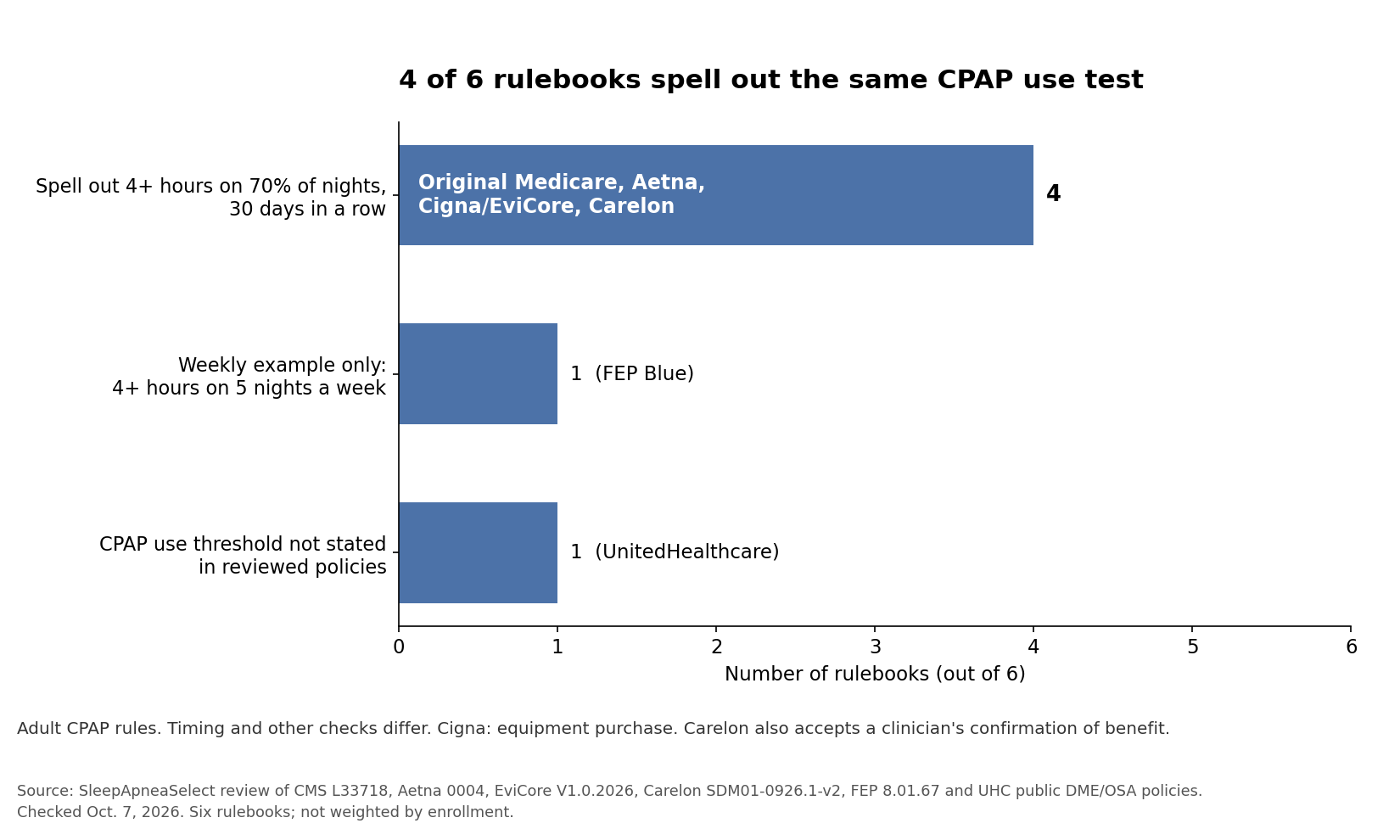
Insurance can cover sleep apnea tests and prescribed CPAP when plan rules are met. In SleepApneaSelect's October 2026 review, 4 of 6 selected adult CPAP rulebooks state a test of 4+ hours a night on at least 70% of nights over 30 consecutive days. Carelon also allows a clinician's confirmation of benefit.
Below are the written rules behind sleep apnea insurance coverage for tests, CPAP, Inspire and Zepbound, side by side, with a source for each. Watch for the Inspire rule: one BMI and sleep-score example fits three insurer policies' limits but falls outside the reviewed Medicare contractor policies.
Key sleep apnea insurance coverage facts
- 4 of 6 sleep apnea coverage rulebooks SleepApneaSelect compared in October 2026 spell out the same numeric adult CPAP use test: at least 4 hours a night on at least 70% of nights, over 30 days in a row. The four are Original Medicare, Aetna, Cigna's EviCore guideline and Elevance's Carelon guideline. Carelon also accepts a treating clinician's report of benefit; timing and extra checks differ. (Our analysis; Table 2; checked Oct. 7, 2026.)
- At least 21 of 30 nights: Medicare's version means 4+ hours of CPAP use on at least 21 nights in any 30 days in a row during your first 3 months, plus a clinical visit, in person or by Medicare-approved telehealth, on days 31–91 documenting better symptoms and review of the use data. (CMS LCD L33718, checked Oct. 7, 2026; our math: 30 × 0.70 = 21.)
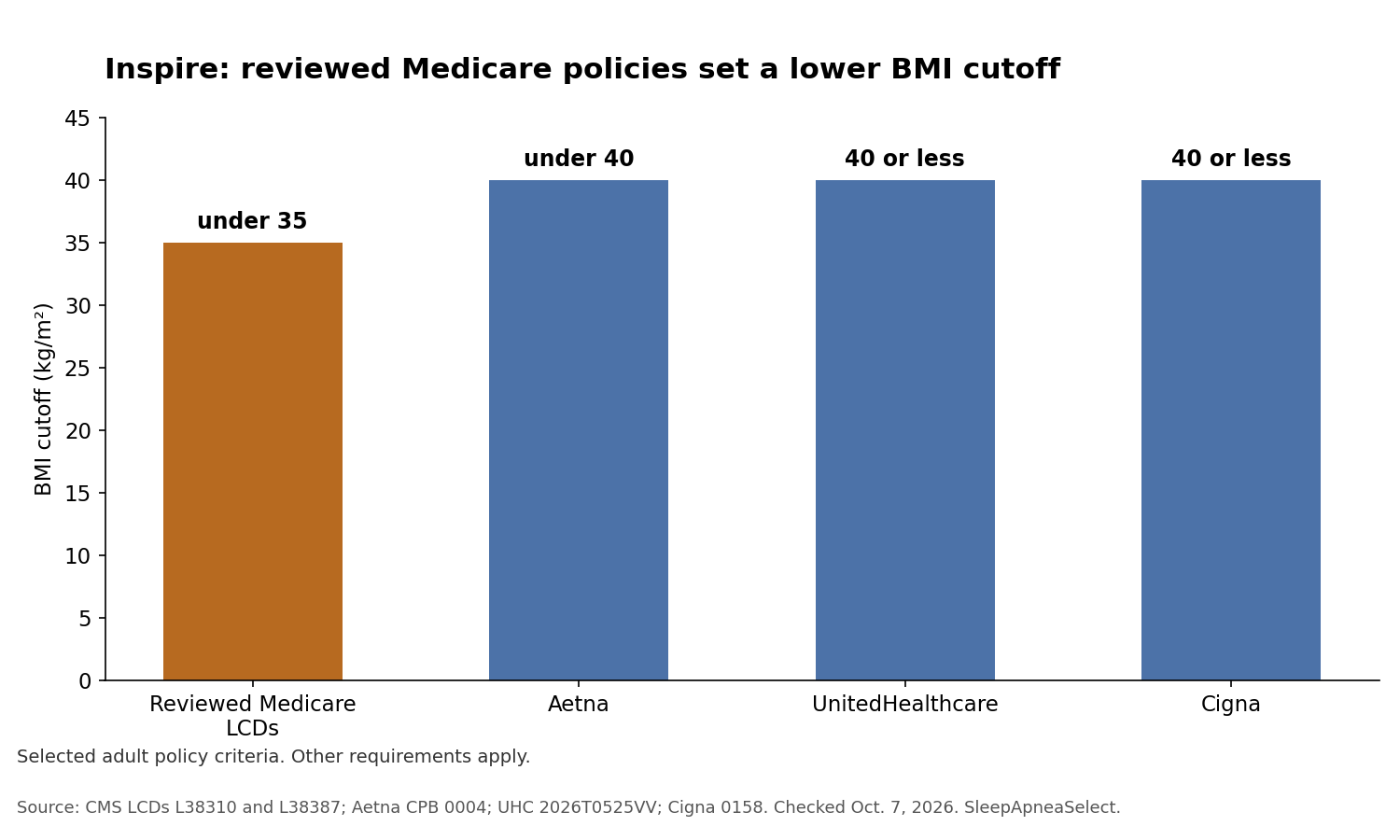
- BMI under 35: The reviewed Medicare contractor policies set an age floor of 22, a body mass index (BMI) under 35 and an apnea-hypopnea index (AHI, breathing events per sleep hour) of 15 to 65 for Inspire. Aetna, UnitedHealthcare and Cigna allow a BMI of 40 or less (under 40 at Aetna) and an AHI of 15–100. These are selected criteria. (CMS LCD L38310 and LCD L38387; Aetna CPB 0004; UHC 2026T0525VV; Cigna 0158; checked Oct. 7, 2026.)
- 3 of 4: For an example adult aged 50 with a BMI of 37 and an AHI of 40, the Inspire BMI and AHI limits at Aetna, UnitedHealthcare and Cigna fit. The reviewed Medicare contractor policies' limits don't. Other criteria still apply. (Our analysis; Table 8; checked Oct. 7, 2026.)
- 6 months vs. 1 year: UnitedHealthcare's reviewed commercial policy gives a 6-month first Zepbound approval for sleep apnea. It asks for symptoms that persist despite qualifying PAP use, or that PAP isn't an option. Cigna's reviewed policy gives a 1-year first approval and lists no prior PAP trial. PAP means positive airway pressure and includes CPAP. (UHC policy effective Sept. 1, 2026; Cigna CNF1006, reviewed June 17, 2026; checked Oct. 7, 2026.)
- The $50 price doesn't apply: Medicare's $50 GLP-1 Bridge copay (July 1, 2026, to Dec. 31, 2027) excludes Zepbound prescribed for moderate to severe sleep apnea in adults with obesity. That use goes through the person's regular Part D drug plan. (CMS, page updated Aug. 6, 2026; checked Oct. 7, 2026.)
- 20% and 13 months: On Original Medicare, your share is 20% of the Medicare-approved amount after the $283 annual Part B deductible (2026), when the supplier accepts assignment. After 13 continuous months of covered rental payments, the CPAP is yours. Other coverage may pay some of your share. (Medicare.gov; CMS; checked Oct. 7, 2026.)
- 4% vs. 3%: Medicare's rule for counting a shallow-breathing event, called a hypopnea, requires an oxygen drop of at least 4%. Aetna accepts a drop of at least 3% or an arousal from sleep. Both also require a breathing reduction of at least 30% for at least 10 seconds. (CMS NCD 240.4; Aetna CPB 0004, reviewed Oct. 6, 2026; checked Oct. 7, 2026.)
- 5 of 6 rulebooks make home testing the starting route for adults who meet home-test criteria and have no listed reason for a lab study. The reviewed CMS PAP documents allow either setting. (Our analysis of the six rulebooks; Table 3; checked Oct. 7, 2026.)
- The test supplier matters: Medicare won't count a home sleep test if a medical-equipment supplier runs any part of it, even delivering or picking up the device. The policy lists exceptions for hospitals certified to perform these tests and for facility-based sleep labs. (CMS Article A52467; checked Oct. 7, 2026.)
- No new test after five years: For a replacement after the five-year useful lifetime, Original Medicare doesn't require a new sleep test or trial if fee-for-service Medicare paid for the first machine. It needs a new order and a visit showing you still have sleep apnea, use the machine and benefit. (Noridian, a Medicare equipment contractor; checked Oct. 7, 2026.)
- Dec. 20, 2024: Zepbound became the first drug approved for obstructive sleep apnea. The approval covers moderate to severe sleep apnea in adults with obesity, with a reduced-calorie diet and increased physical activity. (FDA; checked Oct. 7, 2026.)
How does sleep apnea insurance coverage compare across plans?
All six rulebooks below allow sleep apnea testing and CPAP when their rules are met. They split on three things: whether you must try a home test first, how they check CPAP use, and how far they go on Inspire and Zepbound. A rulebook here means the written policy or guideline a plan uses to decide what it pays for.
| Rulebook | Who it applies to | Home test first? | CPAP use rule | Inspire limits | Zepbound for sleep apnea |
|---|---|---|---|---|---|
| Original Medicare | Original Medicare; Part D is a separate drug benefit | The reviewed PAP documents accept a qualifying home or lab test | 4+ hrs on at least 70% of nights, 30 days in a row, in the first 3 months; benefit and use review on days 31–91 | Reviewed contractor policies: age 22+, BMI under 35, AHI 15–65 | Separate Part D plan; not the $50 Bridge |
| Aetna (CPB 0004) | Aetna medical plans, subject to each member's benefits | Yes, unless a listed reason applies | Same 70% test during the first period of use; face-to-face visit | Age 18+, BMI under 40, AHI 15–100 | Not reviewed |
| Cigna (EviCore guideline; policies 0158 and CNF1006) | Plans that use the relevant Cigna rule for each service | Yes, unless a listed reason applies | For adult equipment purchase: same 70% test in the first 3 months; clinical re-check | Age 18+, BMI 40 or less, AHI 15–100 | 1-year first approval; no prior PAP trial listed |
| Carelon guideline (Elevance Health) | Plans using this guideline; start dates vary by plan | Yes, unless a home test isn't suitable | Adults: same 70% test within the past 90 days, or your treating clinician confirms CPAP is helping; checked every 90 days in year one | Not included | Not applicable |
| FEP Blue (BCBS Federal Employee Program) | Federal employees, retirees and families in the Service Benefit Plan | Yes, for high-risk adults without complicating conditions | Example only: review at 90 days, 4+ hrs on at least 5 nights a week | Not included | Not reviewed |
| UnitedHealthcare | Commercial and Exchange medical plans; the drug policy here is commercial | Yes, unless a listed reason applies | No CPAP-specific use threshold stated in the public DME and OSA policies reviewed | BMI 40 or less, AHI 15–100 | 6-month first approval; symptoms persist despite qualifying PAP use, or PAP is not an option |
Source: SleepApneaSelect Coverage Rules Tracker, built from each rulebook's published documents (see Sources); checked Oct. 7, 2026. These are selected adult criteria; the full policies have more.
A few words that show up a lot:
- AHI (apnea-hypopnea index) is how many times an hour your breathing stops or gets shallow while you sleep.
- CPAP (continuous positive airway pressure) is a prescribed machine that blows air through a mask to keep your airway open.
- "Not stated" means we didn't find that rule in the public documents. It doesn't mean there's no rule, and it doesn't mean a claim will be paid.
What is the 4-hour CPAP rule?
It's the numeric part of Medicare's test for keeping CPAP covered: at least 4 hours a night on at least 70% of nights, during any 30 days in a row in your first 3 months. That works out to at least 21 of 30 nights. Aetna, Cigna's EviCore guideline and Elevance's Carelon guideline state the same numeric test, with different timing and other checks. Carelon also accepts a treating clinician's confirmation of benefit.
Think of it as a scorecard the machine keeps. The use record shows when you use CPAP, and your clinician reviews it.
The math is friendlier than it sounds. At least 21 nights out of 30 must meet the 4-hour mark, so no more than 9 nights in that window can fall below it (30 − 21 = 9).
One thing it's not: a sleep goal. It's an insurance paperwork rule. How long you should use CPAP each night is between you and your clinician.
| Rulebook | Use rule as written | When it's checked | Also needed | Our grouping |
|---|---|---|---|---|
| Original Medicare | 4+ hours a night on at least 70% of nights, 30 days in a row | Any 30-day stretch in the first 3 months | Clinical visit, in person or by Medicare-approved telehealth, on days 31–91 documenting better symptoms and review of objective use data | Spells out the numeric test |
| Aetna | 4+ hours a night on at least 70% of nights, 30 days in a row | Any time during the first period of use | Face-to-face visit; symptoms better; use data reviewed | Spells out the test |
| Cigna (EviCore guideline) | For equipment purchase: 4+ hours a night on at least 70% of nights, 30 days in a row | Any time in the first 3 months | Clinical re-check in the first 3 months | Spells out the numeric test |
| Carelon guideline (Elevance) | Adults: 4+ hours a night on 70% of nights, 30 days in a row, or your treating clinician confirms CPAP is helping | Within the past 90 days; every 90 days in year one, then once a year | — | Spells out the test, with an "or" |
| FEP Blue | Example: 4+ hours a night on at least 5 nights a week | Review at 90 days | — | Weekly example only |
| UnitedHealthcare | No CPAP-specific use threshold stated in the public DME and OSA policies reviewed | — | When no specific policy applies: InterQual DME, then InterQual Medicare DME, then CMS equipment-contractor criteria | Threshold not stated in reviewed policies |
Source: CMS LCD L33718; Aetna CPB 0004; EviCore Cigna Sleep Disordered Breathing Guidelines V1.0.2026; Carelon Sleep Disorder Management guideline; FEP Blue policy 8.01.67; UHC policy MP.009.35; UHC OSA treatment policy 2026T0525VV. Grouping by SleepApneaSelect. Checked Oct. 7, 2026.

Is FEP Blue's "5 nights a week" the same thing?
Close, but not the same. Five of 7 nights is about 71%, so it lands near 70%. But FEP Blue's example uses a week rather than a 30-day window. It is an example, not a firm cutoff.
What happens if Medicare's first CPAP trial fails?
To qualify again after a failed initial trial, Medicare requires a clinical visit, in person or by Medicare-approved telehealth, to assess why CPAP didn't work, plus a repeat sleep study in a sleep lab (a Type I study). A late follow-up visit is a different case: if the required benefit and use evidence is present, coverage can restart from the date of that visit.
Does anyone check again later?
Carelon's guideline does. For adults, it asks for proof of qualifying use or a treating clinician's confirmation of benefit every 90 days in your first year and once a year after that. Medicare's written test looks at one 30-day window in your first 3 months.
CGS, a Medicare equipment contractor, says the initial numeric use test does not have to be documented again after the first three months. Suppliers must still document continued use.
Will insurance pay for a sleep apnea test?
Yes, when the test meets the plan's rules and a clinician orders it for signs of sleep apnea. Original Medicare covers qualifying home tests (Types II, III and IV) and lab studies (Type I, done in a sleep lab), and your share is 20% of the Medicare-approved amount after the Part B deductible. Five of the six rulebooks we compared make home testing the starting route for adults who meet home-test criteria and have no listed reason for a lab study.
A home sleep apnea test is a small device you wear for a night or more in your own bed. A lab study (polysomnography) means sleeping overnight at a sleep center while staff watch.
| Rulebook | Home test | When a lab study comes first or next | Listed BMI threshold for a lab study |
|---|---|---|---|
| Original Medicare | Types II, III and qualifying Type IV or other accepted devices | The reviewed PAP documents accept a qualifying home or lab test; no home-first step is imposed there | No BMI threshold is imposed by that route |
| Aetna | Type II, Type III, Type IV with airflow plus 2 more channels, or a WatchPAT-type device | Listed health problems, other sleep disorders, a negative or failed home test, low chance of sleep apnea, or not able to use the device safely | BMI over 45 |
| Cigna (EviCore guideline) | When an adult's evaluation raises concern for sleep apnea | Listed reasons, including a home test that didn't give an answer | BMI 45 or more |
| UnitedHealthcare | For adults with suspected sleep apnea | A negative or unclear home test in the past 12 months, under 18, or listed health problems | BMI 50 or more |
| FEP Blue | For high-risk adults with no condition that changes their breathing | Moderate or high pretest probability, plus a listed reason such as not meeting home-test rules or an earlier failed or inadequate home test | No BMI cutoff stated |
| Carelon guideline | When its risk criteria are met | Risk criteria plus a reason home testing is unsuitable, such as specified lung or heart disease, another listed sleep disorder, or inability to apply the equipment when no helper is available | Not checked |
Source: Medicare.gov Sleep Studies; CMS LCD L33718; Aetna CPB 0004; EviCore V1.0.2026; UHC Sleep Studies 2026T0334SS; FEP Blue 2.01.18; Carelon Sleep Disorder Management guideline. CMS NCD 240.4.1. Checked Oct. 7, 2026.
Here's a quirk in that last column. For an adult being assessed for suspected sleep apnea, a BMI of 47 meets Aetna's and Cigna's weight-based reason for a lab study. It does not meet UnitedHealthcare's BMI threshold of 50. Another listed reason could still make a lab study appropriate.
Will a cash home test count later for CPAP?
It can, but only if the test and the report meet your plan's rules. Before you pay cash, check three things:
- The device type. Medicare accepts Types II and III, plus Type IV devices with at least 3 channels including airflow. It also accepts devices with at least 3 channels for movement, oxygen and peripheral arterial tone (pulse-related blood-vessel changes). A Type IV label alone isn't enough. Aetna names the device types it accepts (see Table 3).
- The full report. Ask for the score and how it was scored. Medicare and Aetna count shallow breaths differently (more on that below).
- Who ran it. On Medicare, a medical-equipment supplier can't run any part of a home sleep test, not even dropping off or picking up the device. The policy lists exceptions for hospitals certified to perform the tests and for facility-based sleep labs.
For timing, CGS says the PAP Devices LCD sets no fixed age limit for a sleep study. Long delays still need an explanation in the medical record, and a new study may be appropriate if your condition has changed.
If you're weighing a cash test, you can compare home sleep test services by what the price includes, and see what to ask before paying for a test.
What if the home test comes back negative or unclear?
UnitedHealthcare points to a lab study after a negative or unclear home test. Its policy says a repeat home test isn't recommended after one negative, unclear or failed result, and it strongly recommends a lab study instead. Aetna and FEP Blue also list a negative or failed home test as a reason for a lab study. Your clinician picks the next test; your plan confirms what it will pay for.
Does insurance cover a CPAP machine?
Yes, when your sleep test score and the plan's other rules are met. For Medicare, the score rule is an AHI or RDI of 15 or more, or 5 to 14 plus findings like excessive daytime sleepiness or high blood pressure. Aetna, Cigna's guideline and FEP Blue use a similar two-step bar, with their own lists of findings.
| Rulebook | Selected score criteria | Extra detail |
|---|---|---|
| Original Medicare | AHI or RDI 15+ (at least 30 events), or 5–14 (at least 10 events) plus excessive daytime sleepiness, thinking or mood problems, insomnia, high blood pressure, ischemic heart disease or a past stroke | A shallow breath counts only with a 4% oxygen drop |
| Aetna | AHI or RDI 15+ (at least 30 events), or 5 to under 15 (at least 10 events) plus a listed condition, such as a past stroke, documented high blood pressure (systolic over 140 mmHg or diastolic over 90 mmHg), ischemic heart disease, an Epworth sleepiness score over 10, or set oxygen drops | The hypopnea rule accepts at least a 3% oxygen drop or an arousal from sleep |
| Cigna (EviCore guideline) | 15+ events an hour, or 5 to under 15 with listed findings | — |
| FEP Blue | Adults: AHI, RDI or REI 15+, or 5+ with at least one sign or symptom, such as daytime sleepiness, high blood pressure, heart disease or stroke | — |
| UnitedHealthcare | Not stated in the public DME and OSA policies reviewed | Uses the criteria hierarchy in Table 2 |
| Carelon guideline | Adults 18+: AHI 15+, or 5–14 with listed symptoms or conditions | The appropriate CPAP level must also be determined |
Source: CMS LCD L33718 and NCD 240.4; Aetna CPB 0004; EviCore V1.0.2026; FEP Blue 8.01.67; UHC MP.009.35; UHC OSA treatment policy 2026T0525VV; Carelon SDM01-0926.1-v2. Checked Oct. 7, 2026. These are events per hour, not percentages.
RDI (respiratory disturbance index) and REI (respiratory event index) are cousins of AHI. They count breathing events per hour too, but each one counts a slightly different set of events or hours.
Why does a 3% vs. 4% oxygen drop matter?
It can change your score. Medicare counts a shallow breath (a hypopnea) only when your oxygen drops at least 4%. Aetna also counts one when oxygen drops at least 3% or there is an arousal from sleep—a brief shift toward waking, which need not mean fully waking up. Both rules also need chest-and-belly breathing movement or airflow to fall by at least 30% from baseline for 10 seconds or more.
So the same night can produce two different scores, depending on which rule the sleep report used. A sleep report can list more than one score. Ask whether yours shows the one your plan uses.
How much does Medicare pay for a CPAP machine?
On Original Medicare, your share is 20% of the Medicare-approved amount after the $283 annual Part B deductible for 2026, when your supplier accepts assignment. After 13 continuous months of covered rental payments, you own the machine. Your share is figured on Medicare's approved amount, not a store's sticker price. Other coverage may pay some of that share.
Assignment means the supplier agrees to take Medicare's approved amount as full payment. The deductible is what you pay each year before Medicare starts paying its share. It's $283 for all Part B services in 2026, not $283 per machine.
| Item | Rule |
|---|---|
| Starting trial | 12 weeks |
| Use window | Any 30 days in a row within the first 3 months |
| Clinician visit | In person or by Medicare-approved telehealth, on days 31–91; documents improved symptoms and review of objective use data |
| Your share | 20% of the Medicare-approved amount after the Part B deductible, with assignment; other coverage may help |
| 2026 Part B deductible | $283 a year |
| Monthly rental rate | Months 4 through 13 are paid at 75% of the months 1–3 rate |
| Ownership | After 13 continuous months of covered rental payments |
Source: CMS NCD 240.4 and LCD L33718; Medicare.gov; CMS 2026 Part B fact sheet; Noridian (Medicare equipment contractor). Checked Oct. 7, 2026.
Here's how the rental math works. Say the first-three-month rental fee is $50 a month for the machine. That's a round number for the math, not a price quote. Assume all 13 months stay covered, the rate stays fixed, the supplier accepts assignment, no other insurance pays, and the annual deductible is met in each year of the rental:
- Months 1–3: you pay 20% of $50, which is $10 a month.
- Months 4–13: the rate drops to 75% of $50, or $37.50, so you pay $7.50 a month.
- Total over 13 months: 3 × $10 + 10 × $7.50 = $105.
What do actual Medicare rental fees look like?
CMS's October 2026 fee file lists $50.04 a month for the first three rental months in the New York and New Jersey non-rural fee columns, outside former competitive bidding areas. The rural columns list $97.02 for New York and $89.86 for New Jersey. Holding those rates fixed gives a modeled machine-only share of about $105, $204 and $189, respectively, over 13 covered months.
| Applicable fee column, outside former competitive bidding areas | Monthly fee for months 1–3 | Modeled 13-month share, before other insurance |
|---|---|---|
| New York or New Jersey, non-rural | $50.04 | About $105 |
| New York, rural | $97.02 | About $204 |
| New Jersey, rural | $89.86 | About $189 |
Source: CMS DME26-D, DMEPOS_OCT.csv, E0601/RR; the included DMEBACK 2026.pdf sets the later-month rate at 75%. Totals calculated by SleepApneaSelect. Checked Oct. 7, 2026.
The math is 20% × [3 × rate + 10 × 75% × rate]. This example assumes the annual Part B deductible is met in every year of the rental, all 13 months stay covered, the supplier accepts assignment, and its charge is no lower than the listed fee. It excludes supplies and holds October 2026 rates fixed for the whole example. Your ZIP code, later fee changes and monthly rounding can change the bill. A separate fee file applies in former competitive bidding areas.
Masks, cushions and filters are billed on their own. Medicare sets usual maximums for how often it pays for each one.
| Supply | Usual maximum |
|---|---|
| Full-face mask | 1 every 3 months |
| Full-face mask cushion | 1 a month |
| Nasal mask | 1 every 3 months |
| Nasal mask cushions | 2 a month |
| Nasal pillows | 2 pairs a month |
| Tubing (regular or heated) | 1 every 3 months |
| Disposable filters | 2 a month |
| Reusable filter | 1 every 6 months |
| Headgear | 1 every 6 months |
| Chinstrap | 1 every 6 months |
| Humidifier water chamber | 1 every 6 months |
Source: CMS LCD L33718 (usual maximum amounts of accessories). Checked Oct. 7, 2026.
These are coverage limits, not a schedule for automatic shipments. Replacement supplies must be needed, and the device must meet Medicare's coverage rules.
To compare what you'd pay outside insurance, see CPAP costs, item by item.
When do you own the machine, and when do you need a new test?
You own it after Medicare makes 13 continuous months of covered rental payments. For a replacement after the five-year useful lifetime, no new sleep test or trial is required if fee-for-service Medicare paid for the first machine. It needs a new order and a visit, in person or by Medicare-approved telehealth, showing you still have sleep apnea, still use the machine and still benefit.
The new-lab-study rule is for a different case: a failed first trial.
This section is about Original Medicare. Medicare Advantage plans can have different rules and costs.
Does insurance cover Inspire for sleep apnea?
Yes, under the reviewed policies, when their criteria are met. The reviewed Medicare contractor policies set an age floor of 22, a BMI under 35 and an AHI of 15 to 65. Aetna, UnitedHealthcare and Cigna go higher: a BMI of 40 or less (under 40 at Aetna) and an AHI of 15–100. These are selected limits, and the policies also check PAP treatment and other factors.
Inspire is an implant that stimulates the nerve that moves your tongue, so the tongue moves forward and the airway stays open while you sleep. BMI (body mass index) is a weight-for-height number in kg/m².
| Rulebook | Age | BMI | AHI | What "CPAP didn't work" means |
|---|---|---|---|---|
| Reviewed Medicare contractor policies | 22+ | Under 35 | 15–65 | AHI still over 15 on CPAP, or under 4 hours a night 5 nights a week, or the CPAP was returned |
| Aetna | 18+ | Under 40 | 15–100 | At least 1 month of CPAP data showing AHI over 15, or under 4 hours a night 5 nights a week |
| UnitedHealthcare | Adults | 40 or less | 15–100 (lab study) | CPAP didn't help, wasn't tolerated or was refused |
| Cigna | 18+ | 40 or less | 15–100 | AHI 15+ on CPAP, can't use it more than 4 hours a night 5 nights a week, or unwilling to use it |
Source: CMS LCD L38310 (Noridian JE/JF) and LCD L38387 (Wellpoint Federal J6/JK); Aetna CPB 0004; UHC 2026T0525VV; Cigna policy 0158. Checked Oct. 7, 2026. AHI is measured in events per hour; BMI is in kg/m².
These policies also check how the airway closes. The reviewed Medicare policies and Cigna require drug-induced sleep endoscopy (DISE), an airway exam under sedation, to rule out complete concentric collapse at the soft palate. That means the airway closes all the way around. Aetna accepts DISE or flexible laryngoscopy for that check. UHC requires DISE and also rules out complete blockage. Each policy has more criteria than this table shows.

Same patient, four answers
Say a 50-year-old has an AHI of 40 and a BMI of 37. Here's how each rulebook's BMI and AHI limits treat that person. This example doesn't assess PAP intolerance or other requirements:
| Rulebook | BMI 37 fits? | AHI 40 fits? | Meets both numeric limits? |
|---|---|---|---|
| Reviewed Medicare contractor policies | No (must be under 35) | Yes | No |
| Aetna | Yes | Yes | Yes |
| UnitedHealthcare | Yes | Yes | Yes |
| Cigna | Yes | Yes | Yes |
Source: Table 7 limits; SleepApneaSelect analysis. Checked Oct. 7, 2026. Meeting these two limits doesn't guarantee approval. Each plan has more criteria.
That's 3 of 4 rows meeting both numeric limits. The example exceeds the BMI limit in the reviewed Medicare policies. A BMI of exactly 35 would still be outside their strict 'under 35' rule.
Cigna's policy also lists a second implant, Genio, with tighter age, BMI and AHI limits: age 22+, BMI 32 or less and AHI 15–65. Its other adult implant criteria still apply.
Does insurance cover Zepbound for sleep apnea?
Some plans do, with approval first. Zepbound (tirzepatide) has been approved since Dec. 20, 2024, for moderate to severe obstructive sleep apnea in adults with obesity. In the policies reviewed, UnitedHealthcare's first approval lasts 6 months; Cigna's lasts 1 year.
Prior authorization means your plan has to say yes before it will pay. The FDA approving a drug for sleep apnea and your plan saying yes are two separate decisions.
| Item | UnitedHealthcare (commercial, sleep-apnea-only policy) | Cigna (national formulary policy) |
|---|---|---|
| Policy date | Effective Sept. 1, 2026 | Reviewed June 17, 2026 |
| First approval lasts | 6 months | 1 year |
| Age | 18+ | 18+ |
| BMI | 30+ | 30+ at baseline |
| Sleep test score | AHI, REI or RDI 15+ events per hour | AHI or REI 15+ events per hour |
| PAP condition (includes CPAP) | Symptoms continue despite PAP use of 4+ hours a night on at least 70% of nights, or PAP isn't an option for you | No prior PAP trial listed |
| Renewal | Weight loss of at least 10% of starting weight, plus other criteria | After 1+ year: weight loss of at least 10% of starting weight and stable sleep apnea symptoms, plus other criteria |
Source: UHC "Zepbound – Obstructive Sleep Apnea Only" prior authorization; Cigna CNF1006. Checked Oct. 7, 2026. These are selected criteria; each full policy has more.
Notice what shows up again in UnitedHealthcare's row: the 4-hour, 70% PAP yardstick, this time as one route to a drug. That drug-policy clause does not state a 30-day window.
Does Medicare's $50 GLP-1 price apply to sleep apnea?
No. The $50 copay belongs to Medicare's GLP-1 Bridge, a short-term program that runs July 1, 2026, through Dec. 31, 2027. CMS says Zepbound for moderate to severe sleep apnea in adults with obesity is already coverable under regular Part D, even if it isn't on your plan's drug list. So it can't go through the Bridge.
| Situation | Route | Price |
|---|---|---|
| Zepbound prescribed for moderate to severe sleep apnea in an adult with obesity | Your regular Part D plan | Your plan's own cost-sharing |
| Eligible GLP-1 use for weight management | Medicare GLP-1 Bridge (July 1, 2026–Dec. 31, 2027) | $50 copay |
Source: CMS, "Medicare GLP-1 Bridge: Information for Part D Plans," updated Aug. 6, 2026. Checked Oct. 7, 2026.
If your Part D plan doesn't list Zepbound, you can ask the plan for an exception. That's a request, not a promise.
What should I ask my plan before I pay?
Start with the exact policy and version your plan will use. Then check the test, the supplier, the paperwork and your share of the cost before you pay. Six questions cover it.
| Ask | Why it matters |
|---|---|
| Which policy, and which version, will you use for my test or machine? | Rules change, and some plans use outside guidelines |
| Does this test, clinician and supplier qualify? | Medicare has specific test-device and test-supplier rules, including hospital and lab exceptions |
| Which report, prescription and use records do you need? | Missing papers are easy to fix early and hard to fix later |
| Do I need prior authorization, and who sends it? | Someone has to ask before the plan pays |
| What's the approved amount, how much deductible do I have left, and what's my share? | Turns "it's covered" into a dollar figure |
| If you say no, what's the reason and the next step? | Points you to the right appeal or exception |
Source: SleepApneaSelect, based on the rules in Tables 1–10.
The rules above call for test and treatment records, so it helps to get your prescription and sleep report in hand first. When you're ready to buy, you can compare prescribed CPAP buying options by package and return terms.
If you're still choosing a test or a machine, Find My Next Step gives you the questions to ask before you pay. It's free, with no sign-up.
Why do these dates matter right now?
Several of these policies changed in 2026, and another version is scheduled for Nov. 5. UnitedHealthcare's sleep apnea treatment policy took effect Oct. 1, 2026. Cigna changed the BMI limit in its Inspire policy on June 15, 2026.
| Date | What happened |
|---|---|
| June 15, 2026 | Cigna's Inspire policy (0158) revised its BMI limits |
| July 1, 2026 | UnitedHealthcare's sleep studies policy took effect; Medicare's GLP-1 Bridge began |
| Sept. 1, 2026 | UnitedHealthcare's Zepbound sleep apnea policy took effect |
| Oct. 1, 2026 | UnitedHealthcare's sleep apnea treatment policy (2026T0525VV) took effect |
| Oct. 6, 2026 | Aetna reviewed its sleep apnea policy (CPB 0004) |
| Nov. 5, 2026 | A new version of Cigna's EviCore sleep guideline (V2.0.2026) is scheduled to take effect |
| Dec. 31, 2027 | Medicare's GLP-1 Bridge ends |
Source: the policy documents listed under Sources. Checked Oct. 7, 2026.
A review date isn't proof a rule changed that day. This page uses the version in force on Oct. 7, 2026, and will recheck Cigna's rows against the new guideline when it takes effect.
How did we build this?
We read the 27 primary-source entries listed below, all checked on Oct. 7, 2026, including CMS's October fee file. We put each rule or calculation in the CSV with its source and date. Then we counted how many rulebooks share each rule. We didn't survey anyone, and the six rulebooks aren't weighted by how many people they cover.
- Which rulebooks. Original Medicare. Three national insurers' own rules (Aetna, Cigna and UnitedHealthcare). The guideline Elevance Health's Carelon writes for plans that adopt it. FEP Blue, which covers federal workers. Together they show how these selected rulebooks write the rules. They aren't every plan in the country.
- Which versions. We used the version in force on the check date, not drafts or future versions. Where a newer version is scheduled, we note it.
- What "spell out the same test" means. All three parts appear in the rule: at least 4 hours a night, at least 70% of nights, and 30 days in a row. FEP Blue's weekly example and the CPAP threshold not stated in the UHC public DME and OSA policies reviewed don't count. We count documents stating the numeric test, not identical coverage conditions. Cigna's clause concerns equipment purchase; Carelon also accepts provider-confirmed benefit.
- What "home first" means. We counted a rulebook as home-first when home testing is an accepted route for an eligible adult and an initial lab study needs a listed exception. This counts policy rules, not patients.
- How to check our counts. Open the CSV and filter care_step to "analysis." Each count lists the rows it comes from. The 21-night figure is 30 × 0.70. The 9-night figure is 30 − 21.
- How we checked the fees. In CMS DME26-D, we read DMEPOS_OCT.csv, selected E0601 with rental modifier RR, blank second modifier and category CR, and read the New York and New Jersey rural and non-rural columns. The file's own background document sets the months 4–13 fee at 75% of the months 1–3 fee. The three totals use 20% × [3 × rate + 10 × 75% × rate]. They hold October rates fixed and round the final result to whole dollars. We did not establish claim-level monthly rounding.
- Limits of the reading. Some plans use licensed criteria that are not contained in the public documents reviewed, like UnitedHealthcare's InterQual criteria. We report the CPAP use threshold as "not stated" instead of guessing. The Medicare implant comparison uses two local contractor policies, not a review of every contractor.
Our general approach to sources is on the methodology page.
What does this data show, and what doesn't it?
It shows what each rulebook's public documents say on Oct. 7, 2026. It doesn't show how often claims get approved, what any one person will pay, or what every plan does.
- Your plan can differ. Employer-plan benefits may differ from an insurer's standard benefits, and your benefits still decide what's covered.
- Approval isn't automatic. Meeting the rules in these tables doesn't guarantee a yes; each policy has more criteria than we list.
- Some plans aren't here. Medicaid, Medicare Advantage medical and equipment rules, and smaller insurers aren't included in this edition. The Part D discussion can apply to stand-alone or Medicare Advantage drug plans.
- No national numbers. This isn't a national coverage rate, a denial rate or an average price. None of those can be drawn from policy documents.
How should I cite this page?
Cite SleepApneaSelect for the comparison, the counts and the math. Cite the agency or insurer for the rule itself.
SleepApneaSelect. "Sleep Apnea Insurance Coverage: What 6 Rulebooks Say in 2026." Updated October 2026. https://sleepapneaselect.com/research/sleep-apnea-coverage-policies/ (rules checked Oct. 7, 2026).
You may reuse SleepApneaSelect's original summaries, counts, tables and charts with credit to SleepApneaSelect. Underlying source material keeps its own attribution and license terms; this permission covers only SleepApneaSelect's original contribution.
Download the data
The free CSV has 76 data rows: the selected rules in the tables above, each with its source link, policy date and check date, plus our counts and math. No email, account or form needed.
File: Download sleep-apnea-coverage-rules-2026-10.csv (October 2026 edition)
Interactive index
Coverage rules lookup
Select a rulebook and care step to view the matching dated records in this edition.
2 matching records
Zepbound for sleep apnea, first approval
SAS-055- Rulebook
- UnitedHealthcare
- Plan scope
- UnitedHealthcare Commercial Plans using this OSA-only pharmacy policy
- Rule
- Zepbound for sleep apnea, first approval
- Value
- 6 months; age 18+; BMI 30+; AHI, REI or RDI 15+ events/hour; continued OSA symptoms despite PAP adherence (4+ hours per night on at least 70% of nights) or not a PAP candidate
- Policy ID
- Zepbound - OSA Only prior authorization 2026 P 1475-3
- Policy date
- effective 2026-09-01
- Checked
- Oct. 7, 2026
- Status
- verified
- Note
- Printed PDF pages 1-2 visually checked: all three index thresholds are greater than or equal to 15. Selected criteria; more requirements apply. The drug-policy PAP clause does not specify a 30-day window.
Zepbound renewal
SAS-056- Rulebook
- UnitedHealthcare
- Plan scope
- UnitedHealthcare Commercial Plans using this OSA-only pharmacy policy
- Rule
- Zepbound renewal
- Value
- Weight loss of at least 10% of baseline body weight, plus other criteria
- Policy ID
- Zepbound - OSA Only prior authorization 2026 P 1475-3
- Policy date
- effective 2026-09-01
- Checked
- Oct. 7, 2026
- Status
- verified
- Note
- —
Frequently asked questions
Will insurance pay for a sleep apnea test?
Yes, when the test meets the plan's rules and a clinician orders it for signs of sleep apnea. Original Medicare covers qualifying home tests (Types II, III and IV) and lab studies (Type I, done in a sleep lab), and your share is 20% of the Medicare-approved amount after the Part B deductible. Five of the six rulebooks we compared make home testing the starting route for adults who meet home-test criteria and have no listed reason for a lab study.
What is the 4-hour CPAP rule?
It's the numeric part of Medicare's test for keeping CPAP covered: 4+ hours a night on at least 70% of nights during any 30 days in a row in your first 3 months, or at least 21 of 30 nights. You also need a clinical visit, in person or by Medicare-approved telehealth, on days 31–91 documenting better symptoms and review of objective use data. It's a paperwork rule, not a sleep goal.
How much does insurance pay for a CPAP machine?
There's no single answer for private plans. Original Medicare leaves you 20% of its approved amount after the $283 Part B deductible (2026), when the supplier accepts assignment. After 13 continuous months of covered Medicare rental payments, you own it.
How often does Medicare require a new sleep study for CPAP?
For a replacement after the five-year useful lifetime, Original Medicare does not require a new sleep test or trial if fee-for-service Medicare paid for the first device. It does require a new order and an in-person or approved telehealth visit documenting sleep apnea, continued use and benefit. A failed first trial is different: that needs a clinical visit meeting Medicare's rules and a repeat study in a sleep lab.
Does UnitedHealthcare cover Zepbound for obstructive sleep apnea?
Its commercial sleep-apnea-only policy, effective Sept. 1, 2026, gives a 6-month first approval when the criteria are met. Those include age 18+, BMI 30+, an AHI, REI or RDI of 15 or more events per hour, and symptoms that continue despite PAP use of 4+ hours a night on at least 70% of nights, unless PAP isn't an option. Check that this policy applies to your plan.
Can I get Zepbound for sleep apnea for $50 through Medicare?
No. The $50 copay belongs to Medicare's GLP-1 Bridge (July 1, 2026, to Dec. 31, 2027). CMS sends Zepbound for sleep apnea through your regular Part D plan instead, at that plan's own cost-sharing.
Does insurance cover Inspire?
Yes, when the applicable policy's criteria are met. Aetna, UnitedHealthcare and Cigna set BMI limits of 40 or less (under 40 at Aetna) and AHI limits of 15–100. The reviewed Medicare contractor policies set age 22+, BMI under 35 and AHI 15–65. These are selected criteria; the policies also check PAP treatment and other factors.
Does insurance cover a mouth device (oral appliance) for sleep apnea?
Some plans do. UnitedHealthcare's commercial and Individual Exchange policy, effective Oct. 1, 2026, requires a sleep-study diagnosis and a record from the treating physician or advanced practice provider that PAP, such as CPAP, didn't help, wasn't tolerated, or was refused. Other medical-necessity rules also apply. Other plans set their own rules.
Do I own my CPAP on Medicare?
Yes, after 13 continuous months of covered Medicare rental payments.
Sources
All sources checked Oct. 7, 2026.
- CMS. Local Coverage Determination L33718, Positive Airway Pressure (PAP) Devices for the Treatment of Obstructive Sleep Apnea. Source. Checked Oct. 7, 2026.
- CMS. National Coverage Determination 240.4, CPAP Therapy for Obstructive Sleep Apnea (effective March 13, 2008). Source. Checked Oct. 7, 2026.
- Medicare.gov. Continuous Positive Airway Pressure (CPAP) therapy. Source. Checked Oct. 7, 2026.
- Medicare.gov. Sleep studies. Source. Checked Oct. 7, 2026.
- CMS. Policy Article A52467, PAP Devices for the Treatment of OSA. Source. Checked Oct. 7, 2026.
- CMS. 2026 Medicare Parts A & B Premiums and Deductibles (fact sheet, Nov. 14, 2025). Source. Checked Oct. 7, 2026.
- Noridian (Jurisdiction D DME). Capped Rental Items (updated Oct. 5, 2026). Source. Checked Oct. 7, 2026.
- Noridian. Positive Airway Pressure (PAP) Devices: Replacement (revised October 2024). Source. Checked Oct. 7, 2026.
- CMS. Local Coverage Determination L38310, Hypoglossal Nerve Stimulation for the Treatment of OSA (services on or after Oct. 16, 2025). Source. Checked Oct. 7, 2026.
- CMS. Local Coverage Determination L38387, Hypoglossal Nerve Stimulation for the Treatment of OSA (services on or after April 1, 2026). Source. Checked Oct. 7, 2026.
- CMS. Medicare GLP-1 Bridge: Information for Part D Plans (updated Aug. 6, 2026). Source. Checked Oct. 7, 2026.
- FDA. FDA Approves First Medication for Obstructive Sleep Apnea (Dec. 20, 2024). Source. Checked Oct. 7, 2026.
- Aetna. Clinical Policy Bulletin 0004, Obstructive Sleep Apnea in Adults (last reviewed Oct. 6, 2026). Source. Checked Oct. 7, 2026.
- EviCore by Evernorth. Cigna Sleep Disordered Breathing Diagnosis and Treatment Guidelines, V1.0.2026 (effective May 1, 2026). Source. Checked Oct. 7, 2026.
- EviCore by Evernorth. Cigna Sleep Disordered Breathing Diagnosis and Treatment Guidelines, V2.0.2026 (effective Nov. 5, 2026). Source. Checked Oct. 7, 2026.
- Cigna. Coverage Policy 0158, Surgical Treatments for Obstructive Sleep Apnea (effective June 15, 2026). Source. Checked Oct. 7, 2026.
- Cigna. CNF1006, Weight Loss – GLP-1 Agonists – Zepbound Prior Authorization Policy (reviewed June 17, 2026). Source. Checked Oct. 7, 2026.
- Carelon Medical Benefits Management. Sleep Disorder Management, SDM01-0926.1-v2 (effective Sept. 19, 2026; last reviewed Jan. 29, 2026). Source. Checked Oct. 7, 2026.
- FEP Blue. Policy 8.01.67, Medical Management of Obstructive Sleep Apnea Syndrome (effective April 1, 2026). Source. Checked Oct. 7, 2026.
- FEP Blue. Policy 2.01.18, Diagnosis of Obstructive Sleep Apnea Syndrome (effective April 1, 2026). Source. Checked Oct. 7, 2026.
- UnitedHealthcare. Sleep Studies, Commercial and Individual Exchange Medical Policy 2026T0334SS (effective July 1, 2026). Source. Checked Oct. 7, 2026.
- UnitedHealthcare. Obstructive and Central Sleep Apnea Treatment, 2026T0525VV (effective Oct. 1, 2026). Source. Checked Oct. 7, 2026.
- UnitedHealthcare. Durable Medical Equipment, Orthotics, Medical Supplies, and Repairs/Replacements, MP.009.35 (effective Feb. 1, 2026). Source. Checked Oct. 7, 2026.
- UnitedHealthcare. Zepbound (tirzepatide) – Obstructive Sleep Apnea Only, Prior Authorization/Non-Formulary (effective Sept. 1, 2026). Source. Checked Oct. 7, 2026.
- CMS. DME26-D, October 2026 DMEPOS fee file: DMEPOS_OCT.csv and DMEBACK 2026.pdf. Source. Checked Oct. 7, 2026.
- CGS. Positive Airway Pressure (PAP) – Supplier, Adherence Monitoring question 5 (answer reviewed Dec. 8, 2025). Source. Checked Oct. 7, 2026.
- CMS. National Coverage Determination 240.4.1, Sleep Testing for Obstructive Sleep Apnea (effective March 3, 2009). Source. Checked Oct. 7, 2026. SleepApneaSelect Research is the research and reference section of sleepapneaselect.com.